Mini Move
A right-sized way to turn in-between moments into movement.
SKILLS
Market Research
UX ResearchProduct DesignPrototyping
TOOLS
Lovable
Figma
Replit
Claude
This is a portfolio project with the intent of exploring applications of AI, not a shipped product.
THE CHALLENGE
Helping busy professionals stay active without dedicated workout time.
Despite strong motivation, busy tech professionals rarely exercised outside scheduled sessions. Most fitness tools assume 30–60 minute workouts, leaving short, unpredictable pockets of time unused.
USER RESEARCH
Understanding real barriers to movement.
As a personal trainer, I spoke with 50+ clients and prospects as part of my work uncovering motivations, goals, and barriers to exercise. Two obstacles consistently surfaced: not knowing what to do and lack of time.
“
Time was the obstacle on the surface. The deeper problem was framing. People needed to feel like three minutes counted, not like three minutes was a failure.
A GAP IN THE FITNESS MARKET
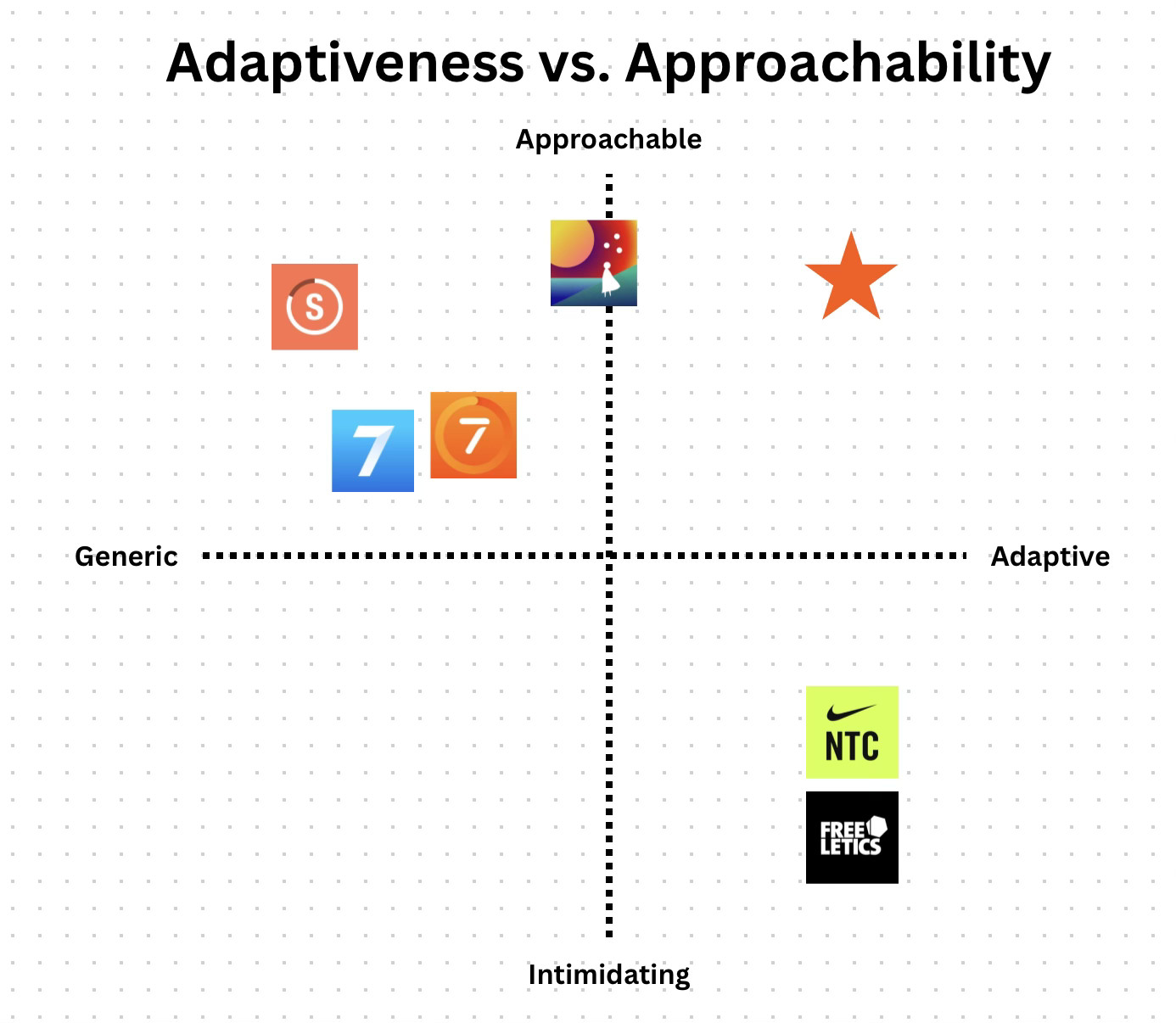
Movement solutions exist, but not in approachable, right-sized moments.
The fitness app ecosystem splits into two extremes: easy to start but static, or personalized but high commitment onboarding flows. Neither supports flexible movement in the in-between moments of the day.
WHO I’M SOLVING FOR
Designing for unpredictable lives.
Sarah, The Squeezed Parent
Exercises in short bursts (screen time, naps, early mornings)
5–15 min windows, limited space, regular clothes
Feels guilty about inconsistency
Elena, The Busy Professional
Gym memberships unused due to travel & erratic hours
Exercises in hotel rooms, offices, airports
Business clothes, no equipment
Marcus, The Shift Worker
Irregular sleep cycles ignored by traditional fitness advice
Works rotating shifts, exercises at odd hours
Limited recovery time
DESIGN PRINCIPLES & JOBS TO BE DONE
How can we embrace the “in-between” moments through movement?
Grounded in habit science and the growing exercise-snacking mindset.
- Start instantly
- Adapt to real life
- Lower perceived effort
- Count every movement
Functional
Help me get movement in when I only have 3 minutes
Give me energy without changing clothes or showering
Help me use available space and minimal setup
Emotional
Help me feel like I’m prioritizing my health despite chaos
Remove guilt around not doing “real” workouts
Give me a quick win that boosts my mood
THE SOLUTION
Mini Move: A right-sized way to turn in-between moments into movement.
Mini Move creates a fast path from “I have a few minutes” to “I’m exercising.” It generates context-aware movement in seconds, adapting to time, energy, and environment.
KEY DESIGN DECISIONS
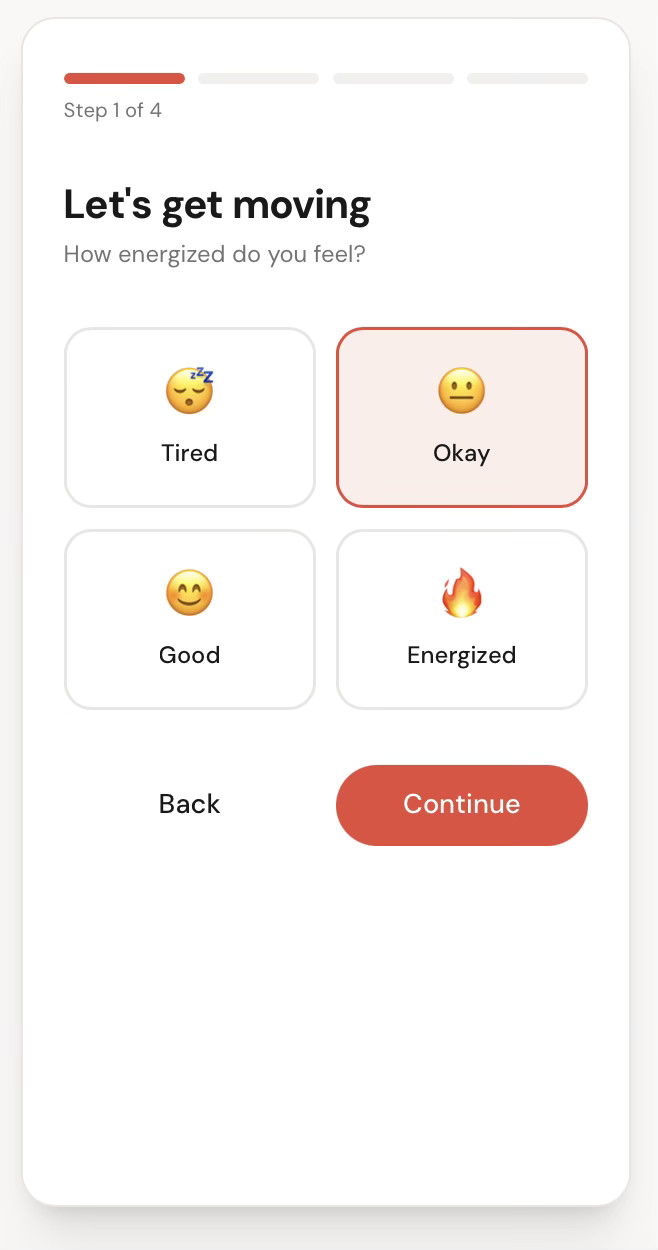
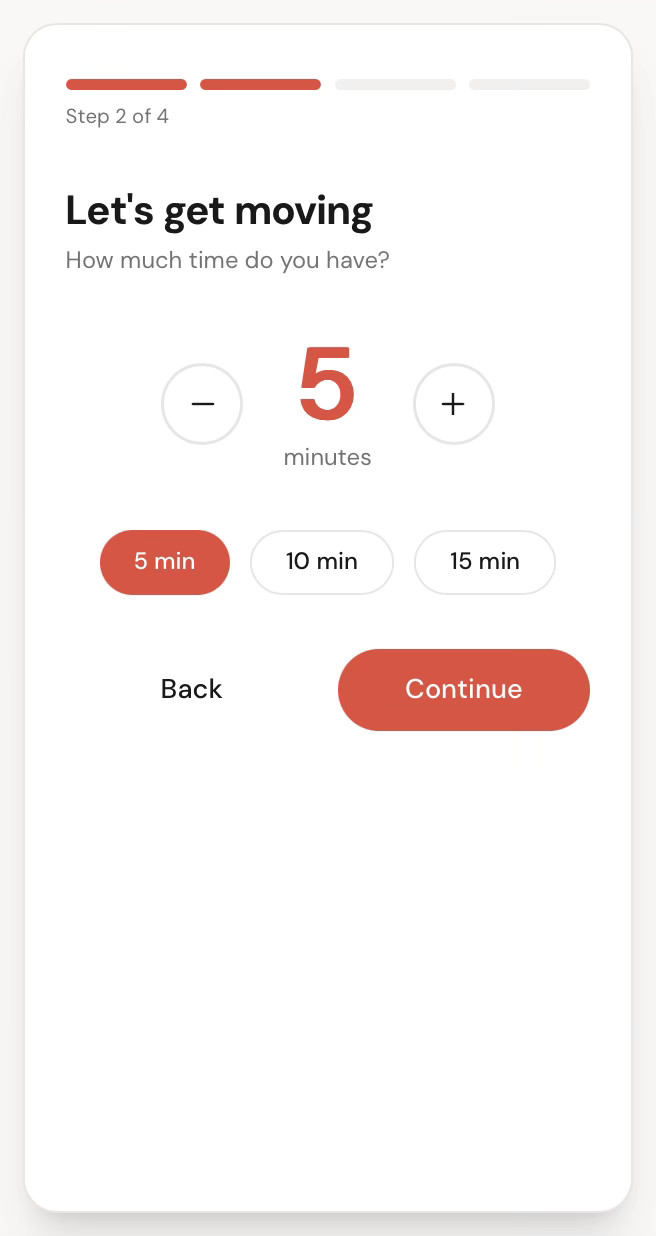
Smart Context Matching
A short assessment recommends workouts based on available time, energy, and setting.
Exercise Snacking
5–15 minute routines informed by research showing benefits from short bursts of movement. Integrated with Exercise DB API to leverage over 1,300 exercises categorized by body part, target muscle, and equipment to align with users’ energy, clothing, space, and time constraints.
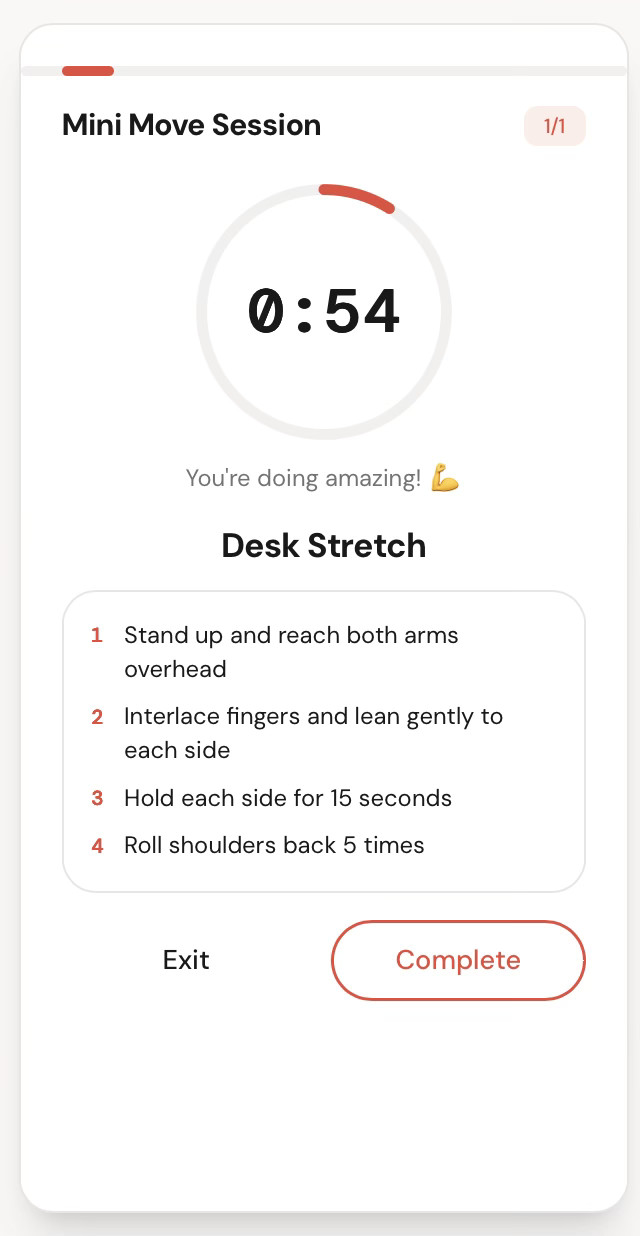
Low-Effort Starts
No planning, no setup, no equipment assumptions.
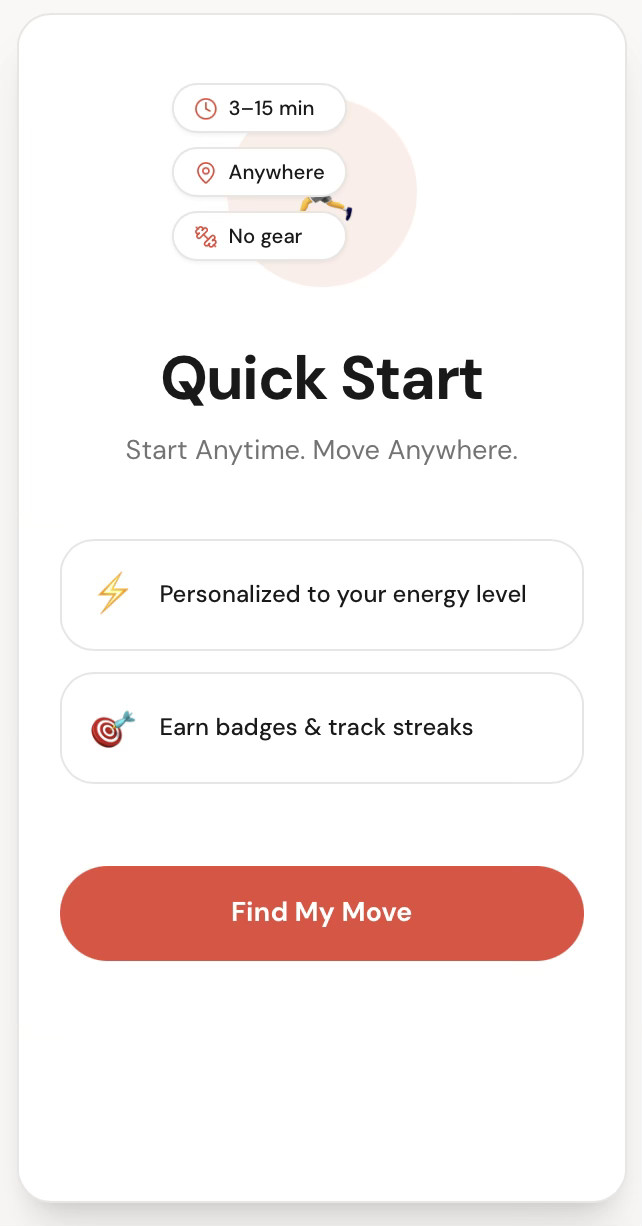
Encouraging Language
Every 30-second effort is treated as progress.
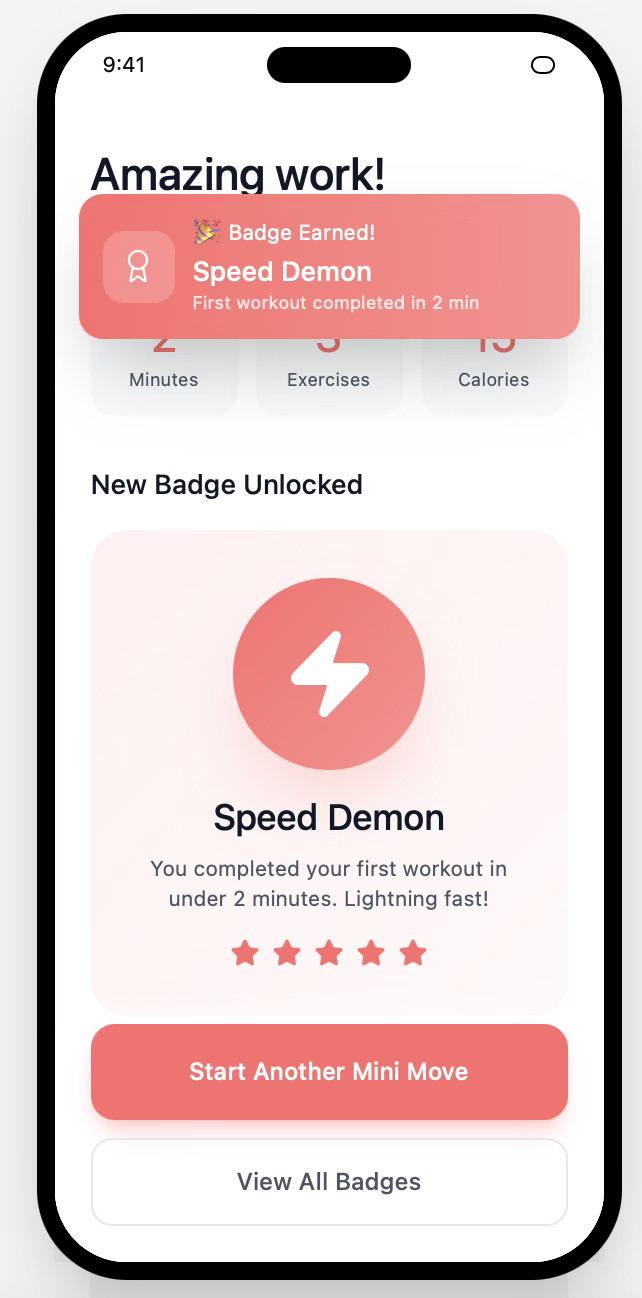
WHY IT WORKS
Small moments compound.
By meeting users where they are, Mini Move turns overlooked micro-moments into sustainable habits. Movement becomes flexible, achievable, and part of everyday life.
VALIDATION & NEXT STEPS
Testing for real-world behavior change.
Especially in fitness, what people say they want to do often doesn’t match what they actually do. Is this lightweight enough to realistically fit into everyday routines, or will it still be deprioritized?
Behavioral validation
Will users complete context-filtered workouts in real scenarios?
Messaging effectiveness
Do positive, playful messages increase motivation without feeling gimmicky?
Sustainable engagement
Does novelty fade after two weeks, and what drives long-term retention?
REFLECTIONS
Built with AI, refined with human judgment.
This case was an exercise in evaluating trade-offs across multiple AI prototyping platforms. I started in Lovable for a fast first concept, moved to Figma for design control, and then used Replit to integrate the Exercise DB API and build real workout logic. Claude helped me iterate quickly across tools.
The most important judgment calls came where AI fell short. For example, when AI delivered an overwhelming survey scroll, I collapsed it into a single-click flow so users could complete it in short bursts, optimizing for activation. AI helped me move fast, but the best results came from combining it with careful design thinking and human judgment.
Mini Move
A right-sized way to turn in-between moments into movement.
SKILLS
Market Research
UX ResearchProduct DesignPrototyping
TOOLS
Lovable
Figma
Replit
Claude
This is a portfolio project with the intent of exploring applications of AI, not a shipped product.
THE CHALLENGE
Helping busy professionals stay active without dedicated workout time.
Despite strong motivation, busy tech professionals rarely exercised outside scheduled sessions. Most fitness tools assume 30–60 minute workouts, leaving short, unpredictable pockets of time unused.
USER RESEARCH
Understanding real barriers to movement.
As a personal trainer, I spoke with 50+ clients and prospects as part of my work uncovering motivations, goals, and barriers to exercise. Two obstacles consistently surfaced: not knowing what to do and lack of time.
“
Time was the obstacle on the surface. The deeper problem was framing. People needed to feel like three minutes counted, not like three minutes was a failure.
A GAP IN THE FITNESS MARKET
Movement solutions exist, but not in approachable, right-sized moments.
The fitness app ecosystem splits into two extremes: easy to start but static, or personalized but high commitment onboarding flows. Neither supports flexible movement in the in-between moments of the day.
WHO I’M SOLVING FOR
Designing for unpredictable lives.
Sarah, The Squeezed Parent
Exercises in short bursts (screen time, naps, early mornings)
5–15 min windows, limited space, regular clothes
Feels guilty about inconsistency
Elena, The Busy Professional
Gym memberships unused due to travel & erratic hours
Exercises in hotel rooms, offices, airports
Business clothes, no equipment
Marcus, The Shift Worker
Irregular sleep cycles ignored by traditional fitness advice
Works rotating shifts, exercises at odd hours
Limited recovery time
DESIGN PRINCIPLES & JOBS TO BE DONE
How can we embrace the “in-between” moments through movement?
Grounded in habit science and the growing exercise-snacking mindset.
- Start instantly
- Adapt to real life
- Lower perceived effort
- Count every movement
Functional
Help me get movement in when I only have 3 minutes
Give me energy without changing clothes or showering
Help me use available space and minimal setup
Emotional
Help me feel like I’m prioritizing my health despite chaos
Remove guilt around not doing “real” workouts
Give me a quick win that boosts my mood
THE SOLUTION
Mini Move: A right-sized way to turn in-between moments into movement.
Mini Move creates a fast path from “I have a few minutes” to “I’m exercising.” It generates context-aware movement in seconds, adapting to time, energy, and environment.
KEY DESIGN DECISIONS
Smart Context Matching
A short assessment recommends workouts based on available time, energy, and setting.
Exercise Snacking
5–15 minute routines informed by research showing benefits from short bursts of movement. Integrated with Exercise DB API to leverage over 1,300 exercises categorized by body part, target muscle, and equipment to align with users’ energy, clothing, space, and time constraints.
Low-Effort Starts
No planning, no setup, no equipment assumptions.
Encouraging Language
Every 30-second effort is treated as progress.
WHY IT WORKS
Small moments compound.
By meeting users where they are, Mini Move turns overlooked micro-moments into sustainable habits. Movement becomes flexible, achievable, and part of everyday life.
VALIDATION & NEXT STEPS
Testing for real-world behavior change.
Especially in fitness, what people say they want to do often doesn’t match what they actually do. Is this lightweight enough to realistically fit into everyday routines, or will it still be deprioritized?
Behavioral validation
Will users complete context-filtered workouts in real scenarios?
Messaging effectiveness
Do positive, playful messages increase motivation without feeling gimmicky?
Sustainable engagement
Does novelty fade after two weeks, and what drives long-term retention?
REFLECTIONS
Built with AI, refined with human judgment.
This case was an exercise in evaluating trade-offs across multiple AI prototyping platforms. I started in Lovable for a fast first concept, moved to Figma for design control, and then used Replit to integrate the Exercise DB API and build real workout logic. Claude helped me iterate quickly across tools.
The most important judgment calls came where AI fell short. For example, when AI delivered an overwhelming survey scroll, I collapsed it into a single-click flow so users could complete it in short bursts, optimizing for activation. AI helped me move fast, but the best results came from combining it with careful design thinking and human judgment.